Inverter vs Conventional Appliances in Nigeria: Which Actually Saves You Money?
Segun Olayemo
29 October 2026 · 22 views
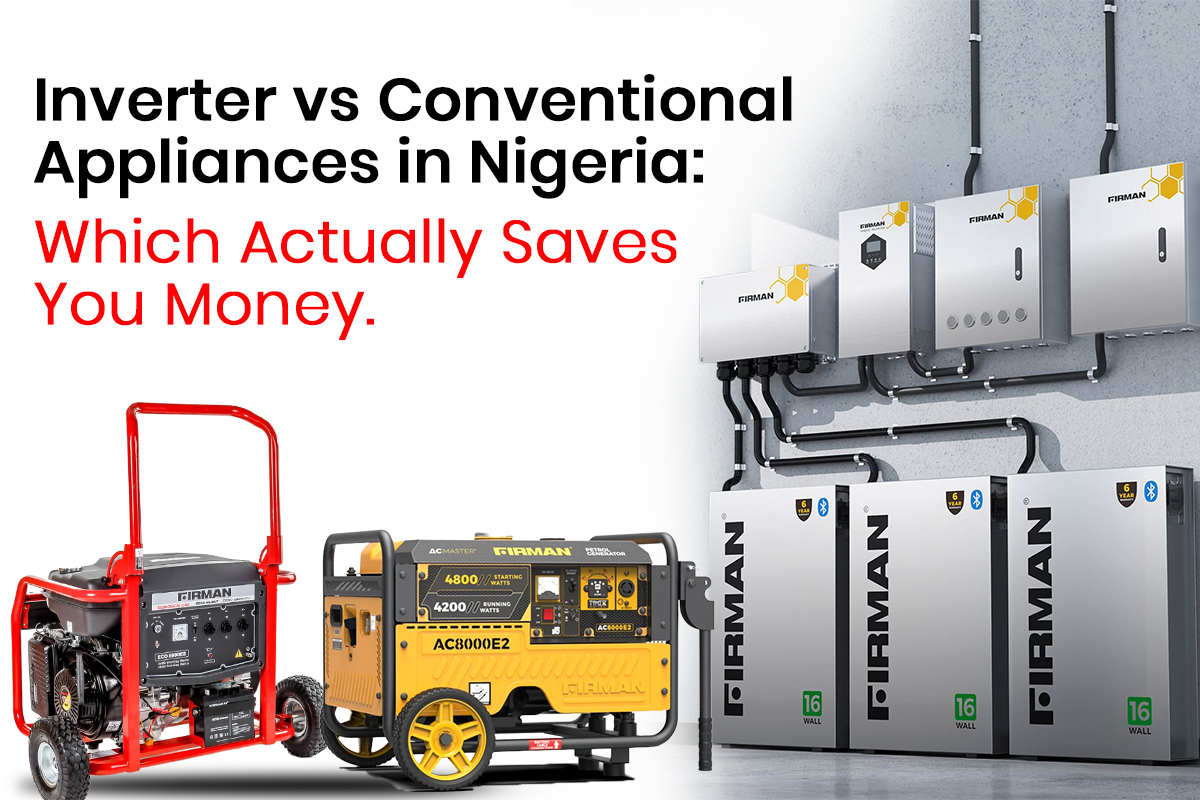
The inverter vs conventional appliances in Nigeria question matters because power is now one of the largest household costs, whether it comes from the grid, a generator, or batteries. An inverter appliance uses a variable-speed compressor that adjusts its effort to demand instead of switching fully on and off. That saves energy on any power source, and it makes a bigger difference here than in most countries. This guide explains how, what it costs, and where the catches are.
Inverter appliances use variable-speed compressors that adjust output to demand, while conventional appliances run at full speed and switch on and off repeatedly. Inverter fridges and ACs typically use less electricity and draw far less startup power, which suits generator, battery and solar setups. They cost more upfront and need voltage protection.
Why This Matters in Nigeria
Power is expensive from every source. Grid tariffs have been restructured by band, generator fuel costs rose sharply after subsidy removal, and battery systems carry high upfront costs. An appliance that uses less energy saves money whichever source you rely on.
Most homes run on more than one power source. A typical Nigerian household moves between grid, generator and inverter battery several times a day. Inverter appliances handle these switches better because they start gently instead of pulling a large surge of current.
Startup surge decides what your backup can run. A conventional fridge or AC compressor draws several times its running power for the first moments after it starts. That surge is often what trips a small inverter or forces you to buy a bigger generator. Inverter compressors ramp up gradually, so a smaller, cheaper backup system can run them.
Voltage fluctuation is the main risk. Inverter appliances depend on an electronic control board (PCB). Surges and unstable voltage, common on Nigerian supply, can damage that board, and replacement is more expensive than repairing a conventional unit. Voltage protection is not optional.
Labels are not always honest. Some appliances are marketed as "inverter" or "energy saving" without a variable-speed compressor inside. Buying genuine, documented products from an authorised retailer is the only reliable way to know what you are getting.
Warranty matters more for inverter appliances. Because the control board is the most likely failure point, check exactly what the warranty covers, especially whether the PCB and compressor have separate terms.
Availability changes. Inverter models are a smaller share of the market than conventional ones, and specific capacities move in and out of stock. Confirm availability before you plan around a model.
Two Meanings of "Inverter" in Nigeria
Much of the confusion in this topic comes from one word being used for two different things.
1. Inverter appliance. A fridge, freezer, AC, washing machine or microwave with a variable-speed motor or compressor. The inverter is inside the appliance and controls how fast it runs. It saves energy.
2. Inverter power system. A backup system that stores electricity in batteries and converts it to household power during outages. It does not save energy by itself; it stores energy for later use.
They are separate purchases, but they work well together. An inverter appliance uses less stored energy and draws a smaller startup surge, so a battery system lasts longer and can be smaller. For a full comparison of backup power options, see the generator vs inverter vs solar guide
How Inverter Compressors Work
Conventional (fixed-speed) compressor
A conventional compressor has two states: fully on or fully off. When the temperature rises above the set point, it starts at full power. When the target is reached, it stops. The temperature drifts, and the cycle repeats.
Every start draws a large surge of current, called inrush current. Every stop lets the temperature swing.
Inverter (variable-speed) compressor
An inverter compressor changes its speed continuously. It runs fast to reach the target temperature, then slows down to hold it, often running steadily at low speed instead of stopping.
The result is fewer starts, a much smaller startup surge, more stable temperatures, and lower average energy use. Many inverter appliances also use brushless DC (BLDC) motors, which are more efficient than older motor designs.
Where the Savings Actually Come From
Inverter appliances save money in three ways. Most buyers only hear about the first.
1. Lower running consumption. Manufacturers commonly claim inverter ACs and refrigerators use around 30–50% less electricity than comparable conventional models. Real savings depend on usage. They are largest for appliances that run many hours a day, such as an AC used every night or a fridge that runs constantly.
2. Smaller startup surge. A conventional compressor's surge can be three to five times its running power. An inverter compressor starts gently. This means your inverter system or generator can be sized smaller, which saves money at purchase, not just on bills.
3. Better match with backup power. On a battery system, lower consumption means more hours of runtime from the same battery. On a generator, lower and steadier load means less fuel and less strain on the engine.
Where savings are small: appliances used rarely or briefly. An inverter microwave used for a few minutes a day will not pay back its premium through electricity savings alone.
Inverter Refrigerator vs Normal Refrigerator
A refrigerator runs 24 hours a day, so efficiency improvements add up quickly.
Inverter refrigerator: steady low-speed running, more stable temperature, quieter operation, lower average consumption, and gentle startup. Easier to run on an inverter battery system through the night.
Normal (conventional) refrigerator: lower purchase price, simpler and cheaper to repair, more tolerant of rough power, but uses more energy and draws a large surge every time the compressor starts.
The Nigerian consideration: frequent power cuts mean a fridge restarts many times a day. Each restart of a conventional compressor brings a full surge. An inverter fridge handles this better, but its control board needs protection from the voltage spike that often comes when power returns. Most fridges also need a short wait before restarting after an outage; a good AVS (automatic voltage switcher) provides this delay automatically.
Inverter Air Conditioner vs Conventional AC
Air conditioners are the largest single load in most Nigerian homes, so this is where the choice matters most.
Inverter AC: reaches the set temperature, then slows down instead of switching off. It keeps the room at a steady temperature with less noise and lower consumption over long running hours. Startup surge is small, so running it from a battery system or a moderately sized generator becomes realistic.
Conventional AC: cheaper to buy, often simpler to repair, but cycles on and off at full power with large startup surges. Running one from a generator usually requires more capacity than its running wattage suggests.
When inverter AC pays off: if you use the AC for several hours daily. If you only use it occasionally, the higher purchase price may take years to recover.
The Catch: Voltage Sensitivity and Repairs
Inverter appliances are not automatically the better choice. Their main weakness is exactly where Nigerian power is weakest.
-
Control boards are sensitive. Surges, spikes and very low voltage can damage the PCB.
-
Repairs cost more. A replacement inverter board usually costs more than common repairs on a conventional unit.
-
Technician skills vary. Not every repairer is trained on inverter systems. Authorised service support matters.
-
Protection is part of the price. Budget for a stabiliser or AVS with every inverter appliance. Without one, the savings can disappear in a single repair bill.
How Much Does It Cost to Run a Generator in Nigeria?
This is the question that changes most buyers' thinking, because fuel usually costs far more than the generator.
The formula
Daily fuel cost = Litres per hour × Hours run per day × Fuel price per litre
Monthly cost = Daily cost × 30
Yearly cost = Daily cost × 365
Generator fuel consumption per hour
Fuel use depends on generator size and how heavily it is loaded. Small petrol generators in the 1–2.5KVA range typically use somewhere around 0.5 to 1.3 litres per hour at moderate load. Running near full load increases consumption. Check the manufacturer's figure for your model.
Worked example: 2.5KVA generator, 6 hours a day
Assuming 1.0 litre per hour:
|
Fuel price (illustrative) |
Daily |
Monthly |
Yearly |
|
₦900 per litre |
₦5,400 |
₦162,000 |
₦1,971,000 |
|
₦1,100 per litre |
₦6,600 |
₦198,000 |
₦2,409,000 |
|
₦1,300 per litre |
₦7,800 |
₦234,000 |
₦2,847,000 |
Fuel prices shown are illustrative points, not current pump prices. Substitute your local price. Maintenance (oil changes, filters, spark plugs) comes on top.
For comparison, the Maxi EK20 2.5KVA generator costs ₦310,300 at SLOT. At any of these fuel prices, two months of fuel at six hours a day costs more than the generator itself.
Where inverter appliances fit in
A generator's fuel use rises with load. Inverter appliances lower and smooth the load, and their small startup surge means you may not need to oversize the generator. A household that switches its AC and fridge to inverter models can often run a smaller generator, burn less fuel per hour, or run the same generator for fewer hours.
Solar Inverter vs Generator in Nigeria
A generator is cheap to buy and expensive to run. A solar inverter system is expensive to buy and cheap to run, because sunlight has no fuel cost.
Inverter appliances improve the solar case. Lower consumption means fewer panels and less battery capacity for the same comfort, so the system costs less to build. Lower startup surge means a smaller inverter can handle the load.
The full cost comparison, including a five-year cost model and a decision tree, is in the generator vs inverter vs solar guide.
How to Reduce Electricity Bills in Nigeria
-
Replace the appliances that run longest first. The fridge, freezer and AC account for most consumption in most homes. Changing these to inverter models gives the largest saving.
-
Size appliances correctly. An oversized AC wastes power; an undersized one runs flat out and never reaches temperature.
-
Set the AC to around 24–25°C. Each degree cooler increases consumption.
-
Keep fridge and freezer doors closed and seals clean. A worn door seal makes the compressor work harder.
-
Clean AC filters and condenser coils regularly. Dust reduces efficiency, especially during harmattan.
-
Protect every compressor appliance with a stabiliser or AVS. It protects inverter boards and prevents damage on power return.
-
Shift heavy use to grid hours. Run washing machines and pumps when grid supply is available rather than on generator or battery power.
-
Turn off standby loads overnight. Decoders, chargers and TVs on standby add up over a month.
Key Features to Consider
Performance
-
Variable-speed (inverter) compressor confirmed in the specification, not just in marketing text
-
Running wattage and, for conventional units, startup surge
-
Energy rating or stated annual consumption (kWh per year)
-
For ACs, cooling capacity matched to room size (HP or BTU)
-
For backup systems, continuous output and surge rating of the inverter, and usable battery capacity
Durability
-
Operating voltage range: wider is better for Nigerian supply
-
Built-in voltage protection, plus external stabiliser or AVS
-
Copper condenser and evaporator coils on ACs and fridges, which generally resist corrosion better than aluminium
-
Local availability of spare parts, especially control boards
-
For batteries, chemistry and cycle life (LiFePO4 lasts much longer than lead-acid)
Warranty
-
Separate terms for compressor, control board and general parts
-
Whether voltage damage is excluded, and what protection the warranty requires
-
Registration at purchase in your name
-
Whether the retailer or an authorised service centre handles claims
-
For batteries and power stations, warranty stated in years and, ideally, cycles
Comparison Table: Inverter vs Conventional Appliances
|
Factor |
Inverter appliance |
Conventional appliance |
|
Compressor operation |
Variable speed, adjusts to demand |
Fixed speed, full on or full off |
|
Electricity use |
Lower, especially for long daily use |
Higher |
|
Startup surge |
Small, gradual start |
Large, several times running power |
|
Temperature stability |
Steady |
Swings with each cycle |
|
Noise |
Quieter |
Louder at each start |
|
Purchase price |
Higher |
Lower |
|
Repair cost |
Higher (control board) |
Lower |
|
Voltage sensitivity |
Higher, needs protection |
Lower, but still benefits from protection |
|
Generator compatibility |
Smaller generator can run it |
Generator must handle surge |
|
Battery/solar compatibility |
Excellent |
Possible but needs larger inverter |
|
Best for |
Appliances running many hours daily |
Occasional use, tight budgets |
SLOT Power Options: Verified Prices
|
Product |
Type |
Price (₦) |
Availability |
|
Petrol generator |
262,600 |
On request |
|
|
Petrol generator |
266,500 |
On request |
|
|
Petrol generator |
310,300 |
In stock |
|
|
Inverter |
249,550 |
On request |
|
|
Hybrid inverter |
626,750 |
On request |
|
|
Hybrid inverter |
1,299,500 |
On request |
|
|
Lontor Lithium Ion Battery CTL-LFP24-100 |
LiFePO4 battery |
970,725 |
On request |
|
Power station |
309,000 |
In stock |
|
|
Power station |
310,000 |
In stock |
|
|
Power station |
425,500 |
In stock |
|
|
Power station |
598,000 |
In stock |
|
|
Power station |
941,000 |
In stock |
|
|
Power station |
2,352,000 |
In stock |
|
|
Power station |
3,638,000 |
In stock |
|
|
Solar panel |
46,000 |
On request |
|
|
Solar panel |
78,000 |
In stock |
|
|
Solar panel |
482,000 |
On request |
Expert Buying Advice
What experts check first. Whether the appliance genuinely has a variable-speed compressor, confirmed in the specification sheet or model documentation. Then the operating voltage range and the warranty terms for the control board. For backup systems, the inverter's surge rating against the startup draw of the appliances it must run.
Common mistakes. Buying an inverter appliance and skipping voltage protection. Assuming the "inverter" sticker means a variable-speed compressor. Sizing a backup inverter for running wattage only, then finding it trips when a conventional fridge starts. Paying the inverter premium for an appliance used only occasionally.
Hidden specs that matter. Minimum operating voltage: a unit that keeps working at lower voltage is more useful on weak supply. Annual energy consumption in kWh, which is a better comparison point than the label. Restart delay behaviour after power returns. For batteries, usable capacity after depth of discharge, not the nominal rating.
Longevity factors. Voltage protection is the biggest single factor for inverter appliances. Regular cleaning of coils and filters keeps compressors from overworking. For generators, oil changes on schedule and avoids continuous full-load running. For batteries, avoiding heat and deep discharge.
Recommended Options at SLOT
If you run a generator now. The Maxi EK20 2.5KVA (₦310,300, in stock) suits a fridge, lights, fans and TV. Smaller needs are covered by the Maxi EM10 (₦266,500) and Haier Thermocool Generator Junior (₦262,600). Pairing any of them with inverter appliances reduces fuel use per hour.
If you want to cut generator hours. A battery system covers the quieter parts of the day and night. The Itel ESE Off Grid Inverter 1PV-1K512U (₦249,550) with a Lontor CTL-LFP24-100 lithium battery (₦970,725) handles lights, fans, TV and electronics. Inverter appliances make the same battery last longer.
If you want no installation. EcoFlow power stations combine battery and inverter in one unit. The River 2 (₦309,000) and River 3 (₦310,000) cover small loads; the Delta 3 2000 Air (₦941,000) handles larger appliances; the Delta Pro (₦2,352,000) and Delta Pro 3 (₦3,638,000) cover much of a home.
If you want to add solar. Panels range from the Eden 50W (₦46,000) to the 400W Foldable Solar Panel (₦482,000). Inverter appliances reduce how many panels you need.
For larger homes. The Itel ESE Hybrid Inverter 1PV-6K48U (₦626,750) and 1PV-12K48U (₦1,299,500) support larger battery banks and solar arrays on 48V systems, with enough capacity for inverter ACs.
Inverter appliances themselves. Ask SLOT about current inverter refrigerator, freezer and AC stock. The LG MWO 2032 Smart Inverter microwave (₦127,900 in August) is one inverter appliance in the range, though as noted above, short-use appliances save less than fridges and ACs.
If the upfront cost is the barrier, spread payment options let you choose the right system instead of the cheapest one.
Market Pricing Insight
Fuel costs drive the decision. Since subsidy removal, fuel has become the largest cost of generator ownership. At six hours a day, two months of fuel can exceed the generator's purchase price. This shifts the value of every appliance that reduces load.
Battery-based products moved faster than generators this autumn. Between 7 September and 13 October 2026, several EcoFlow power stations rose in price at SLOT: the River 2 by about 15% (₦268,500 to ₦309,000), the River 2 Pro by 13% (₦529,000 to ₦598,000), the Delta Pro 3 by 8%, and the Delta 3 2000 Air by 6%. Over the same period, the Maxi and Haier Thermocool generators, the Itel inverters and the Lontor battery did not change. Imported battery products can reprice quickly, so a quote is worth confirming close to purchase.
Inverter appliances carry a premium. Inverter fridges and ACs cost more than conventional equivalents. The premium is recovered through lower consumption, and faster when the appliance runs long hours or runs on generator power, where each kWh costs more.
Generator electricity is the most expensive electricity. Per unit of energy, generator power typically costs several times more than grid power because of fuel prices and small-engine inefficiency. Every kWh an inverter appliance saves is worth most when it would have come from a generator.
Battery prices dominate backup systems. The Lontor lithium battery (₦970,725) costs nearly four times the Itel 1PV-1K512U inverter (₦249,550). Reducing load with inverter appliances lets you buy less battery capacity, which is where the largest savings in a backup system sit.
Pro Tips From SLOT Experts
-
Upgrade the AC and fridge first. They run longest, so they save most.
-
Buy the stabiliser or AVS at the same time as the appliance. Do not plan to add it later.
-
Size backup systems to surge, not running power, if you still have conventional compressors in the house.
-
Check the restart delay on fridges and freezers. A good AVS waits a few minutes before reconnecting after an outage.
-
Do not run a generator near full load all day. It burns more fuel and wears the engine. Leave headroom.
-
Track your generator fuel for one week. Most people underestimate their real monthly spend.
-
Run heavy appliances during grid hours. Save battery and generator power for essentials.
-
Keep coils and filters clean. Dust raises consumption on every appliance, inverter or not.
-
Confirm the warranty covers the control board, and keep the receipt and serial number together.
-
Combine solutions. Inverter appliances, a battery system and a smaller generator together usually cost less to run than a large generator alone.
Common Mistakes Buyers Make
-
Confusing inverter appliances with inverter power systems. One saves energy; the other stores it.
-
Skipping voltage protection on inverter appliances. A single surge can cost more than years of savings.
-
Trusting the label without checking the specification. Not every "inverter" or "energy saving" appliance has a variable-speed compressor.
-
Ignoring startup surge when sizing backup power. Conventional compressors can trip an inverter that looks big enough on paper.
-
Judging a generator by its price, not its fuel bill. Fuel is the real cost.
-
Paying the inverter premium for rarely used appliances. The payback is slow.
-
Buying from unverified sellers. Without documentation, warranty claims on control boards and batteries are almost impossible.
-
Running a generator indoors or in an enclosed space. Carbon monoxide is odourless and deadly. Always run generators outdoors, away from doors and windows.
Frequently Asked Questions
Are inverter appliances worth it in Nigeria? Yes, for appliances that run many hours a day, such as refrigerators, freezers and air conditioners. They use less electricity, start with a much smaller surge, and work better on generators, batteries and solar. They need voltage protection and cost more upfront.
What is the difference between an inverter refrigerator and a normal refrigerator? An inverter refrigerator uses a variable-speed compressor that runs steadily at the speed needed. A normal refrigerator switches its compressor fully on and off. The inverter model uses less power, keeps a steadier temperature and draws a smaller startup surge, but costs more and needs voltage protection.
How much does it cost to run a generator in Nigeria? Multiply litres per hour by hours run and by the fuel price. A 2.5KVA petrol generator using about 1 litre per hour for 6 hours a day costs roughly ₦6,600 a day at ₦1,100 per litre, or about ₦198,000 a month, before maintenance.
How much fuel does a generator use per hour? Small petrol generators in the 1–2.5KVA range typically use around 0.5 to 1.3 litres per hour at moderate load. Larger generators and heavier loads use more. Check the manufacturer's rating for your model.
Can an inverter AC run on a generator or solar system? Yes, and more easily than a conventional AC, because inverter ACs start gradually without a large surge. The generator or solar inverter still needs enough continuous capacity for the AC's running power.
Do inverter appliances need a stabiliser? Yes. Their electronic control boards are sensitive to surges and unstable voltage. A stabiliser or automatic voltage switcher (AVS) protects the board and is often required to keep warranty coverage.
Which is better for home use in Nigeria, a solar inverter or a generator? A generator costs less to buy but much more to run. A solar inverter system costs more upfront but has almost no running cost. Many homes combine both, using solar and batteries for daily needs and a generator for heavy loads.
Where can I buy genuine inverter appliances and power solutions in Nigeria? Buy from authorised retailers such as SLOT Systems that supply genuine, documented products with manufacturer warranty and after-sales support.
Conclusion
The inverter vs conventional appliances in Nigeria decision comes down to how long an appliance runs and what powers it. For fridges, freezers and air conditioners that run for hours every day, inverter models use less energy and start without the heavy surge that strains generators and battery systems. That lowers fuel bills, extends battery runtime, and can let you buy a smaller backup system. For appliances used briefly, the premium is harder to justify.
The savings depend on protection and genuine products. An inverter appliance without a stabiliser, or one that is not really inverter at all, will not deliver what you paid for. Buy documented products with a real warranty, and treat voltage protection as part of the purchase.
Ready to reduce your household power costs? Explore generators and power solutions at SLOT Nigeria to compare your options and find a setup that suits your energy needs and budget.
Segun Olayemo