Generator vs Inverter vs Solar in Nigeria: The Complete Guide to Powering Your Home in 2026
Segun Olayemo
9 September 2026 · 1,146 views
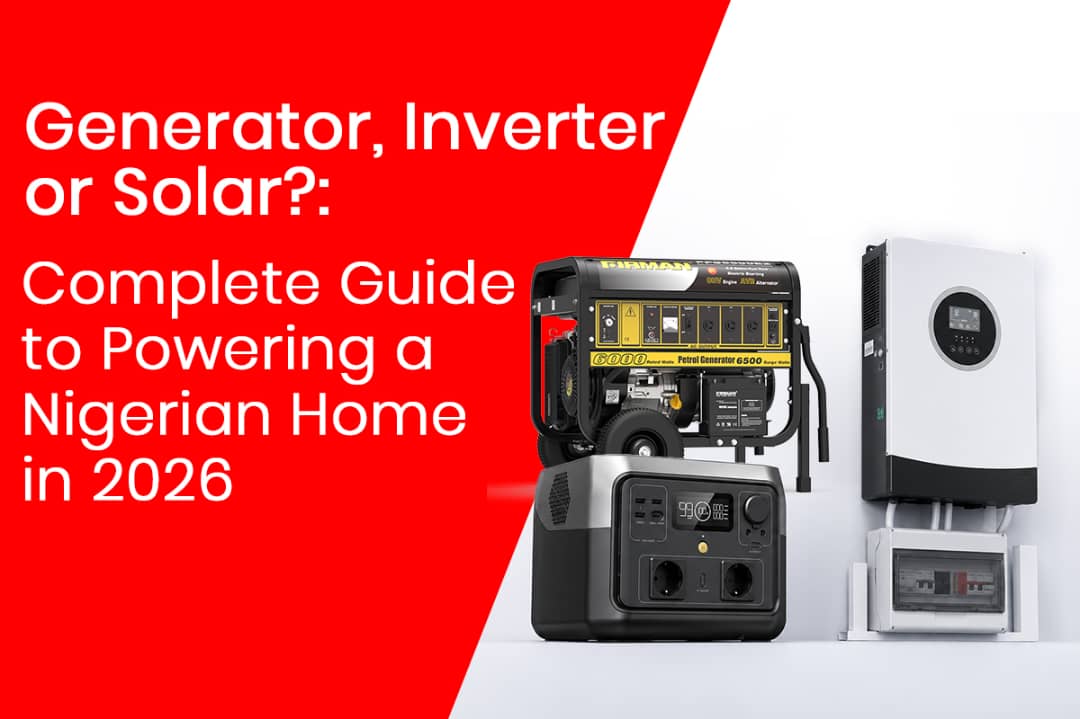
In the generator vs inverter vs solar Nigeria comparison, each solves a different problem. A generator produces power on demand and handles heavy loads, but burns fuel continuously. An inverter stores grid power in batteries and releases it silently during outages, it stores energy, it does not generate it.
Solar generates and stores its own power with near-zero running cost, but carries the highest upfront price. Entry points in Nigeria run from about ₦266,500 for a 1.25KVA generator and ₦268,500 for a small power station, to ₦1.2 million for an inverter-and-lithium-battery setup. Most homes end up best served by a hybrid: solar-plus-battery for daily loads, generator held in reserve for heavy or extended demand.
Why This Decision Matters More in Nigeria Than Almost Anywhere Else
Nigerian households face a power situation that makes this decision unusually consequential.
Grid supply is unreliable and unevenly distributed. Outage frequency and duration vary widely by location and DisCo. A system that works in one neighborhood may be badly matched a few kilometers away. This is why generic international advice fails here; the correct answer depends on your actual grid availability, not a national average.
Fuel is now the dominant cost, not the hardware. This is the single most misunderstood part of the decision. Following subsidy removal, petrol and diesel became a major recurring household expense. A generator's purchase price is a one-time number; its fuel bill is a permanent monthly line item that frequently exceeds the purchase price within the first two years of heavy use. Buyers who compare only sticker prices systematically choose the most expensive option over any meaningful timeframe.
Electricity tariff restructuring changed inverter economics. Band-based tariffs mean the cost of charging an inverter battery from the grid now varies significantly by customer band. Inverter systems remain far cheaper to run than generators, but the calculation is no longer trivially favourable everywhere.
Counterfeit and grey-market equipment is a genuine risk. This applies most severely to batteries and inverters. A battery sold as lithium that is actually a repackaged lead-acid cell, or one with a capacity rating well below what its label claims, is common enough to be a real hazard. Capacity fraud is difficult to detect at purchase and only becomes apparent months later when runtime falls short. The same applies to inverters with inflated wattage ratings that fail under actual load. Buying from an authorized retailer with a verifiable warranty is the only practical protection, because a battery that underperforms is worthless without recourse.
Safety is not a footnote here. Carbon monoxide poisoning from generators run in enclosed or poorly ventilated spaces kills Nigerians every year. This is the most serious risk in this entire category, and it is entirely preventable. Any generator must run outdoors, well away from windows, doors and vents; never in a garage, corridor, balcony enclosure or under a covered walkway, even with a door open.
Availability fluctuates. Battery and panel stock in particular moves with shipment cycles. Confirming live availability before committing to a specific configuration prevents a half-built system waiting on a component.
Understanding the Three Options Properly
Before comparing, it's worth correcting the most common confusion in this market.
What a Generator Actually Is
A generator is an engine driving an alternator. It generates electricity by burning fuel. Output is rated in KVA (kilovolt-amperes), and this is where sizing errors begin: KVA is apparent power, not usable power. Real usable output is KVA × power factor, and for typical small generators the power factor is around 0.8.
So a 2.2KVA generator delivers roughly 1,760W of usable power, not 2,200W. A 7KVA unit delivers roughly 5,600W. Sizing against the KVA figure rather than the usable figure is why so many generators run permanently overloaded.
Strengths: high output for the price, unlimited runtime while fuel lasts, handles heavy inductive loads like air conditioners and pumps, unaffected by weather or grid state.
Weaknesses: fuel cost dominates lifetime expense, noise, emissions, carbon monoxide risk, regular mechanical maintenance, cannot run indoors, and needs someone present to start and refuel it.
What an Inverter System Actually Is
This is where most buyers go wrong. An inverter does not generate electricity. It converts stored DC battery power into AC mains power. The battery must be charged from somewhere, usually the grid, sometimes a generator.
An inverter system is therefore energy storage, not energy generation. It shifts power you have already paid for from when it was available to when you need it. If your grid supply is very poor, an inverter alone will struggle, because there isn't enough available window to recharge the batteries.
A typical system comprises: an inverter (rated in VA or W), a battery bank (rated in Ah at a given voltage), and charging circuitry.
Model designations encode this. The Itel ESE Off Grid Inverter 1PV-1K512U indicates roughly 1kW output on a 12V/48V configuration, enough for lights, fans, TV, laptops, phone charging and a router, but not an air conditioner or electric kettle. The 1PV-6K48U and 1PV-12K48U hybrid units step up to roughly 6kW and 12kW on 48V systems, which brings heavier loads into range.
Strengths: completely silent, zero emissions, safe indoors, no fuel, minimal maintenance, instant automatic switchover during outages.
Weaknesses: runtime limited by battery capacity, requires adequate grid hours to recharge, batteries are a consumable that must eventually be replaced, and heavy loads are usually out of reach.
What Solar Actually Is
Solar combines generation and storage: panels produce DC power, a charge controller regulates it into batteries, and an inverter converts it to AC. Once installed, fuel cost is zero.
Panel output in Nigeria depends on peak sun hours, the equivalent hours of full-intensity sunlight per day. Nigeria receives roughly 4.5 to 6.5 peak sun hours depending on region, with the north generally higher than the humid south, and the rainy season reducing yield noticeably in southern states.
A useful working calculation: a 110W panel in a location averaging 5 peak sun hours produces about 550Wh gross, and after real-world losses, heat derating, wiring, charge and discharge inefficiency delivers roughly 400 to 470Wh of usable energy per day. That is enough for lights, phone charging and a laptop, but it is a modest contribution. Meaningful solar for a household requires panels measured in kilowatts, not hundreds of watts.
Strengths: no fuel cost, silent, no emissions, very low maintenance, long panel lifespan (typically 20-25 years with gradual output decline), and independence from both grid and fuel supply.
Weaknesses: highest upfront cost, output varies with weather and season, needs unshaded roof or ground area, and battery replacement remains a future cost.
How to Size Your System: The Load Audit
Every good power installation starts here, and skipping this step is the root cause of most disappointing systems.
Step 1: List every appliance you need on backup. Not everything you own. Everything you actually need running during an outage.
Step 2: Record running wattage for each. Use the nameplate rating on the appliance, not an estimate.
Step 3: Account for surge. Anything with a motor or compressor; refrigerator, freezer, air conditioner, water pump; draws three to five times its running wattage for the first few seconds of startup. Your inverter or generator must handle that spike, not just the steady draw. This is the most commonly ignored specification in the entire category, and it is the reason systems that look adequately sized on paper trip repeatedly in practice.
Step 4: Multiply by hours needed. Running watts × hours = watt-hours (Wh). This is your daily energy requirement, and it determines battery capacity.
Step 5: Size the battery to usable capacity, not nominal. Critical distinction, covered below.
Indicative Household Load Bands
|
Household profile |
Typical backup load |
Daily energy need |
Suitable approach |
|---|---|---|---|
|
Studio / single occupant — lights, fan, phone, laptop, router |
200–400W |
1–2 kWh |
Portable power station or small inverter + solar |
|
Small family — lights, fans, TV, router, small fridge |
500–900W |
3–5 kWh |
1.2–2.4kVA inverter + battery bank, solar optional |
|
1,000–2,000W |
5–10 kWh |
Larger inverter + solar array, or hybrid with generator |
|
|
3,000W+ |
12 kWh+ |
Hybrid: solar/battery for base load, generator for AC and surge |
Load bands are engineering guidance based on typical appliance ratings, not measured figures for any specific home. A proper load audit is the only accurate method.
Battery Technology: Where the Real Money Is Won or Lost
For inverter and solar systems, the battery determines both performance and lifetime cost. Two chemistries dominate the Nigerian market.
Depth of Discharge - The Specification Nobody Explains
A battery's rated capacity is not its usable capacity. Depth of discharge (DoD) is the proportion you can actually use without damaging the cell.
-
Tubular / lead-acid: safe DoD around 50%. A 200Ah tubular battery gives roughly 100Ah of usable capacity. Discharging deeper shortens its life sharply.
-
LiFePO4 (lithium iron phosphate, "LFP"): safe DoD around 80–90%. A 100Ah LFP battery gives roughly 80–90Ah usable.
This means a 100Ah LFP battery delivers comparable usable energy to a 200Ah tubular battery, at a fraction of the weight and several times the cycle life. Comparing the two on Ah alone as most buyers do makes lithium look far more expensive than it actually is.
The Lontor CTL-LFP24-100 (₦970,725) is a 24V, 100Ah LFP battery: roughly 2.4–2.56kWh nominal, giving about 2.0–2.2kWh usable at 85% DoD.
Cycle Life - The Other Half of the Equation
-
Tubular: typically, 500–1,500 cycles depending on quality and how deeply it is routinely discharged.
-
LiFePO4: typically, 3,000–6,000+ cycles.
At one cycle per day, that's roughly 1.5 - 4 years for tubular against 8–16 years for LFP. Cost per usable kilowatt-hour over the battery's life is the only fair comparison, and on that measure LFP is usually substantially cheaper despite costing more upfront.
The Practical Comparison
|
Factor |
Tubular / Lead-Acid |
LiFePO4 (LFP) |
|---|---|---|
|
Upfront cost |
Lower |
Higher |
|
Usable depth of discharge |
~50% |
~80–90% |
|
Cycle life |
500–1,500 |
3,000–6,000+ |
|
Weight |
Heavy |
Roughly 1/3 the weight |
|
Maintenance |
Some types need topping up; needs ventilation |
None |
|
Cost per usable kWh over life |
Higher |
Lower |
|
Charge speed |
Slower |
Faster |
|
Partial charging tolerance |
Poor - damaged by chronic undercharging |
Excellent |
That last row matters enormously in Nigeria. Lead-acid batteries are damaged by being left partially charged, which is exactly what happens when grid supply is too poor to complete a charge cycle. LFP tolerates partial charging without harm, making it structurally better suited to unreliable grid conditions, a point rarely made in comparisons written for other markets.
Charge Controllers: MPPT vs PWM
For any solar system, the charge controller sits between panels and battery, and the type materially affects harvest.
-
PWM controllers are cheaper and simpler but waste energy whenever panel voltage exceeds battery voltage, which is most of the time.
-
MPPT controllers actively track the panel's maximum power point, typically harvesting 20–30% more energy from the same panels.
MPPT is the correct choice for essentially any system above token size, the additional cost is recovered through higher yield.
Sizing note: a 60A MPPT charge controller supports roughly 1,440W of panel capacity on a 24V battery bank, or about 2,880W on a 48V bank. Higher system voltage lets the same controller handle more panels, which is one reason larger installations run at 48V.
All-in-One Power Stations: The Third Path
Portable power stations combine battery, inverter and charge controller in a single unit. They install in seconds, require no electrician, and most accept solar input directly.
Portable power station price ladder
|
Model |
Price (₦) |
Availability |
Suited to |
|---|---|---|---|
|
110,400 |
On request |
Phone charging, lights, router |
|
|
217,000 |
In stock |
Solar input for any station below |
|
|
268,500 |
In stock |
Lights, router, laptop, fan |
|
|
Eden 300W Portable Powerbank |
273,000 |
On request |
Lights, router, small electronics |
|
310,000 |
In stock |
Lights, router, laptop, phones |
|
|
313,900 |
In stock |
Small appliances, extended electronics |
|
|
425,500 |
In stock |
Longer runtime, more devices |
|
|
442,000 |
In stock |
Mid-tier electronics and lighting |
|
|
529,000 |
In stock |
Small fridge runs, power tools |
|
|
EcoFlow Delta 3 2000 Air |
886,000 |
On request |
Larger appliances, short fridge/freezer runs |
|
Eden 2000W Solar Generator |
1,250,000 |
On request |
Substantial load with solar input |
|
2,352,000 |
In stock |
Significant portion of a home, expandable |
|
|
3,366,000 |
In stock |
Whole-home capable, highest output |
The ladder above is the clearest illustration of a point worth stating plainly: portable capacity is expensive per kilowatt-hour. You pay for the integrated electronics, the output ports, and the fact you can carry it. A fixed inverter and battery bank at equivalent storage generally costs less.
Where power stations make sense: renters who cannot install fixed equipment, anyone needing portability, small loads, or a fast solution without installation work.
Where they don't: whole-home backup at lower cost per kWh. A fixed inverter and battery bank of equivalent capacity is generally cheaper, because you aren't paying for portability, integrated electronics and multiple output ports.
The Decision Framework

Work through these in order. The first honest "no" points you to your answer.
1. Do you need to run an air conditioner, electric water heater, pressing iron or electric cooker on backup?
Yes: You need a generator, at least for those loads. Battery systems large enough for sustained air conditioning are expensive enough that a hybrid is almost always the better economic answer. Continue to question 2 for your remaining loads.
No: Battery-based options are viable. Go to question 3.
2. Do you also want silent, automatic power for lights, fans and electronics?
Yes: Hybrid - generator for heavy loads, inverter or solar for everything else. This is the most common well-designed configuration in Nigerian homes.
No: Generator alone, sized to your total load with surge headroom.
3. How many hours of grid supply do you get on a typical day?
8 or more: A grid-charged inverter works well. Solar is optional, and adding it later is straightforward.
4 to 8: Inverter will work but recharging is tight. Solar is strongly recommended to supplement.
Under 4: Grid-charged inverter is not viable, there isn't enough window to recharge. You need solar generation, or a generator to charge the batteries.
4. Do you own the property, or have a roof you can install on?
Yes: Fixed solar plus battery is the strongest long-term option.
No: A portable power station with a folding panel gives you solar benefits without permanent installation.
5. Is your constraint upfront cash or monthly running cost?
Upfront cash: A generator is cheapest to buy and most expensive to run. If this is your constraint, ask about spread-payment options rather than defaulting to the cheapest hardware, buying the right system on a payment plan usually beats buying the wrong one outright.
Monthly cost: Solar plus LFP battery has the lowest running cost by a wide margin.
The Three Options Compared
|
Factor |
Generator |
Inverter (grid-charged) |
Solar + Battery |
|---|---|---|---|
|
Generates power? |
Yes |
No - storage only |
Yes |
|
Upfront cost |
Lowest |
Moderate |
Highest |
|
Running cost |
Highest (fuel) |
Low (grid charging) |
Near zero |
|
Noise |
High |
Silent |
Silent |
|
Emissions / CO risk |
Yes - must run outdoors |
None |
None |
|
Safe indoors |
No |
Yes |
Yes |
|
Heavy loads (AC, pump) |
Excellent |
Limited |
Possible but costly |
|
Runtime |
Unlimited while fuelled |
Battery-limited |
Battery + daily generation |
|
Needs grid supply |
No |
Yes, to recharge |
No |
|
Weather dependent |
No |
No |
Yes |
|
Maintenance |
Regular - oil, filters, plugs |
Minimal |
Minimal (panel cleaning) |
|
Automatic switchover |
Manual unless auto-start fitted |
Yes, instant |
Yes, instant |
|
Consumable to replace |
Fuel, oil, parts |
Battery |
Battery |
|
Typical lifespan |
5–10 yrs with maintenance |
Inverter 5–10 yrs, battery varies |
Panels 20–25 yrs |
Upfront Cost vs Five-Year Cost
This is the table that changes minds, and it's built as a calculation model rather than fixed figures - fuel prices move too fast for hard-coded numbers to stay honest.
The formula
5-year total cost = Purchase price
+ (Fuel cost per year × 5)
+ (Maintenance per year × 5)
+ Battery replacements over 5 years
+ Grid charging cost over 5 years
Annual fuel cost = Hours run per day × Litres per hour × Fuel price per litre × 365
Worked structure
|
Generator (Maxi EM10, 1.25KVA) |
Generator (Maxi EK20, 2.5KVA) |
Inverter + LFP |
Inverter + LFP + Solar |
Power Station + Solar |
|
|---|---|---|---|---|---|
|
A. Purchase price |
₦266,500 |
₦310,300 |
₦1,220,275 (1PV-1K512U + CTL-LFP24-100) |
₦1,437,275 (above + 110W panel) |
₦527,000 (River 3 + 110W panel) |
|
B. Fuel L/hour |
~0.5–0.8 |
~0.9–1.3 |
0 |
0 |
0 |
|
C. Annual maintenance |
Oil, filters, plugs, servicing |
Higher — larger engine |
Negligible |
Negligible |
Panel cleaning only |
|
D. Battery replacements in 5 yrs |
None |
None |
1–3 replacements (500–1,500 cycles) |
0 (3,000+ cycles) |
0 |
|
E. Annual grid charging |
— |
— |
Band tariff × kWh cycled |
Band tariff × kWh cycled |
₦0 |
|
5-YEAR TOTAL |
A + 5(D+E) |
A + 5(D+E) |
A + 5(E+G) |
A + 5E |
A + 5E |
Key Features to Consider
Performance
-
Usable output, not headline rating, KVA × 0.8 for generators, VA × 0.8 for inverters
-
Surge capacity, at three to five times running watts for any motor or compressor load
-
Battery usable capacity after depth of discharge, not nominal Ah
-
MPPT rather than PWM charge control on any solar system of consequence
-
Pure sine wave output, modified sine wave can damage sensitive electronics and cause motors to run hot
-
Switchover speed and whether transfer is automatic
-
For generators: whether the alternator is copper-wound (better heat tolerance and longevity) or aluminum
Durability
-
Engine type and cooling for generators; air-cooled units are common at household sizes and need genuine airflow clearance
-
Battery cycle life at your actual depth of discharge, not at the manufacturer's most favourable test condition
-
Ingress protection on any outdoor-mounted component
-
Panel frame construction and glass quality, which determine survival through harsh sun and rain cycles
-
Local spare parts availability, a brand with no parts pipeline is disposable when a component fails
-
Voltage tolerance and surge protection, given Nigerian grid conditions
Warranty
-
Duration, and specifically whether battery and inverter carry different terms, they usually do
-
Whether battery warranty is stated in years, cycles, or both; cycle-based terms are more meaningful
-
What voids coverage: unauthorized installation, wrong charge controller pairing and over-discharge are common exclusions
-
Whether the retailer services claims directly or refers you elsewhere
-
Registration in your name at point of sale, documented rather than promised
Expert Buying Advice
What experts check first. The load audit, before any product discussion. A system specified without one is a guess. After that: usable capacity rather than nominal ratings, surge headroom against your largest motor load, and for batteries cycle life at realistic depth of discharge. Then whether the warranty is real and serviceable locally.
Common mistakes. Sizing to nominal KVA instead of usable watts. Ignoring surge current, then wondering why the inverter trips when the freezer kicks in. Buying an inverter with insufficient grid hours to recharge it. Comparing battery prices per Ah instead of per usable kWh over life. Pairing a large panel array with an undersized charge controller, capping harvest permanently.
Hidden specs that matter. Inverter idle or standby consumption a unit drawing significant power doing nothing quietly drains your bank overnight. Battery C-rate, which caps how fast you can discharge and therefore what loads you can actually support. Charge controller maximum input voltage, which determines how many panels you can wire in series. Panel temperature coefficient, which matters more than most buyers realize in Nigerian heat, since output falls as cells get hot. Generator noise rating in decibels, which varies far more between models than buyers expect.
Longevity factors. Batteries fail early for predictable reasons: chronic over-discharge, heat, and being left partially charged for extended periods. Keeping batteries in a ventilated, shaded location measurably extends life. Generators fail from skipped oil changes and running overloaded, a generator held at near-maximum output continuously will not reach its rated lifespan. Solar panels degrade slowly and predictably; their main enemies are shading, soiling and poor mounting.
Recommended Options at SLOT by Household Profile
Renter or small load, no installation possible. A portable power station handles lights, router, laptop, fan and phone charging with no wiring and no landlord conversation. The EcoFlow River 2 (₦268,500) and EcoFlow River 3 (₦310,000) sit at the practical entry point, with the Itel Power Go IESS-320T (₦110,400) covering phone-and-lights-only needs. Adding an EcoFlow 110W solar panel (₦217,000) makes any of them self-sufficient for small daily loads.
Small family, moderate grid supply. The Itel ESE Off Grid Inverter 1PV-1K512U (₦249,550) paired with a Lontor CTL-LFP24-100 LFP battery (₦970,725) gives roughly 1kW of silent output and about 2.0–2.2kWh of usable storage enough for lights, fans, TV, router and electronics through a typical outage. Note the ratio: the battery costs nearly four times the inverter. That is normal and worth understanding — in battery systems, storage is the expensive component, and it is where cutting corners costs most.
Longer runtime or heavier loads. Stepping up to the Itel ESE Hybrid Inverter 1PV-6K48U (₦626,750) or 1PV-12K48U (₦1,299,500) brings roughly 6kW and 12kW into range on a 48V bank enough for refrigeration and, at the upper end, air conditioning. Both will need multiple batteries to be useful; size the bank to your daily kWh requirement, not to the inverter rating.
Poor grid supply, needs generation. Where grid hours fall below four per day, an inverter alone cannot recharge. EcoFlow 110W (₦217,000) and Eden 50W monocrystalline (₦46,000) panels add generation. Be realistic about scale: a 110W panel yields roughly 400–470Wh per day, so meaningful household supply means panels totalling kilowatts. Ten 110W panels approach 1.1kW — the arithmetic is worth doing before budgeting.
Occasional outages, heavy loads, lowest upfront cost. The Maxi EK20 (2KW / 2.5KVA) at ₦310,300 delivers roughly 2,000W usable adequate for a fridge, lights, fans and a TV. The Maxi EM10 (1KW / 1.25KVA) at ₦266,500 and Haier Thermocool Generator Junior at ₦262,600 cover lighter needs. Compare these against the power stations: the Maxi EK20 costs about the same as an EcoFlow River 3 while delivering several times the output, but burns fuel every hour it runs, where the River 3 does not.
Whole-home ambition without installation. The EcoFlow Delta Pro (₦2,352,000) or Delta Pro 3 (₦3,366,000) covers substantial household load with solar input and expansion batteries. The Eden 2000W Solar Generator (₦1,250,000) offers a mid-point. At these prices, a fixed inverter-and-battery installation is worth costing as an alternative, you will generally get more storage per naira, at the cost of portability and an installation job.
The configuration most Nigerian homes actually end up with is a hybrid: solar and LFP storage carrying lights, fans, electronics and refrigeration, with a generator kept in reserve for air conditioning, pumping, extended cloudy stretches, or occasional heavy demand. A Maxi EK20 (₦310,300) alongside an Itel inverter and LFP battery is a realistic worked example of this pattern. It costs more than either approach alone, and it is usually the arrangement people stop complaining about.
Explore the full power and energy range and the Eden Power collection, and ask about spread payment options if upfront cost is the constraint rather than the monthly bill.
Market Pricing Insight: How Nigerian Power Equipment Prices Behave
Fuel prices reshaped the entire category. Subsidy removal did more than raise generator running costs, it permanently altered the economics of the comparison. Systems that looked extravagant when fuel was cheap became straightforwardly rational, and demand shifted accordingly toward inverter and solar solutions. This is a structural shift, not a temporary swing.
Battery cost is the dominant line item in any storage system. Current pricing makes this concrete: a single 2.4kWh LFP battery at ₦970,725 costs almost four times the ₦249,550 inverter it pairs with. Anyone budgeting for an inverter system who has priced only the inverter has budgeted for roughly a fifth of the project. This is the most common budgeting error in the category.
Lithium prices have trended favourably against lead-acid. Global LFP cell manufacturing scale has narrowed the upfront gap between lithium and tubular batteries considerably compared to several years ago. Combined with lithium's superior cycle life, the total-cost case has strengthened materially and continues to.
Solar panel costs per watt have fallen globally over the long term, driven by manufacturing scale. In Nigeria this is partly offset by import duties, shipping and exchange rate movement, so local prices have not fallen as steeply as global module prices.
Exchange rate exposure is near-total. Panels, inverters, lithium cells and generators are all imported or built from imported components. Naira depreciation feeds into retail prices within weeks, and the adjustment is asymmetric prices rise faster on depreciation than they fall on appreciation.
Demand is seasonal in a way that affects price. Generator demand firms up during periods of poor grid performance and around festive seasons. Solar demand rises in the dry season when yields are highest and visible. Buying counter-seasonally is one of the few reliable ways to pay less for identical equipment.
Tariff banding has become a real variable. Because grid-charging cost now differs materially by customer band, the running-cost advantage of a grid-charged inverter over a generator varies by location. It remains an advantage in essentially all cases — but its size differs, and for higher-band customers solar charging becomes proportionally more attractive.
Read Also: Home Appliance Prices in Nigeria (2026): What Fridges, ACs, Freezers, Washers and Cookers Actually Cost
Practical implication: the lowest price available is rarely the lowest cost. A cheaper battery with overstated capacity, a cheaper inverter with an inflated wattage rating, or a cheaper panel with poor temperature performance all cost more over any meaningful period. Verified specifications and a serviceable warranty are what separate a low price from a good one.
Pro Tips From SLOT Experts
-
Do the load audit before discussing products. Twenty minutes with appliance nameplates and a calculator prevents the most expensive mistakes in this category.
-
Size the inverter to surge, not to running watts. Take your largest motor load, multiply by four, and confirm the inverter handles it.
-
Compare batteries on cost per usable kWh over cycle life, never on price per Ah. This single change in method reverses many apparent conclusions.
-
Never run a generator in an enclosed space. Not a garage, not a corridor, not a covered balcony outdoors, well clear of windows and vents. Carbon monoxide is odourless and kills quickly.
-
Choose MPPT over PWM for any solar system worth installing. The yield difference recovers the cost.
-
Keep batteries cool and ventilated. Heat is the primary driver of battery degradation, and a shaded, airflow-adequate location adds years.
-
Build for expansion. Choose an inverter and controller that accommodate additional panels and batteries later. Most people scale up; few plan for it.
-
Design at 48V rather than 24V for larger systems. Higher voltage means lower current, thinner cabling, less resistive loss, and more panel capacity per controller.
-
Insist on pure sine wave output. Modified sine wave costs less and runs motors hot while shortening the life of sensitive electronics.
-
Confirm what the warranty actually covers, particularly whether battery terms are expressed in cycles or years. Cycles tell you far more.
Not sure which configuration fits your home? SLOT offers a free power-needs assessment over WhatsApp, share your appliance list and typical grid hours, and our team will size a system to your actual load rather than a generic package.
Common Mistakes Buyers Make
-
Confusing an inverter with a generator. An inverter stores; it does not generate. Buying one with inadequate grid hours to recharge it produces a system that runs flat and stays flat.
-
Sizing to nominal ratings. KVA is not watts. Nominal Ah is not usable Ah. Both errors produce systems that underdeliver against expectation.
-
Ignoring surge current. The freezer that draws 150W running draws far more on startup. Systems specified without surge headroom trip repeatedly.
-
Comparing batteries on price per Ah. This makes lithium look expensive and tubular look cheap, and reverses the actual five-year outcome.
-
Running a generator indoors or in a partially enclosed space. The most dangerous mistake in this category, and entirely avoidable.
-
Undersizing the charge controller. A 60A MPPT caps panel capacity at roughly 1,440W on 24V. Exceeding it wastes the panels you paid for.
-
Skipping maintenance. Generators need oil changes on schedule. Panels need cleaning. Neither is expensive; both are routinely deferred until something fails.
-
Buying unverified batteries to save money. Capacity fraud is real, difficult to detect at purchase, and leaves no recourse without a warranty from an accountable retailer.
-
Running a generator at continuous maximum output. Sustained full load shortens engine life substantially. Size with headroom.
-
Optimizing for upfront price alone. The cheapest system to buy is reliably the most expensive to own.
Frequently Asked Questions
1. Which is better, an inverter or a generator?
They solve different problems. A generator produces power on demand and handles heavy loads like air conditioners, but burns fuel continuously. An inverter stores grid power and releases it silently, with much lower running cost, but is limited by battery capacity and needs adequate grid hours to recharge. Homes with heavy loads and poor grid supply often need both.
2. What is the cost of solar in Nigeria?
Solar cost depends on daily energy requirement, battery capacity and panel array size rather than on a single package price. A small system covering lights and electronics costs a fraction of one running refrigeration and air conditioning. A load audit is the only way to get an accurate figure, SLOT provides free assessments via WhatsApp.
3. How much does a home power system cost in Nigeria?
Verified September 2026 pricing: small generators from ₦262,600 (Haier Thermocool Junior) and ₦266,500 (Maxi EM10 1.25KVA), a 2.5KVA Maxi EK20 at ₦310,300, portable power stations from ₦268,500 (EcoFlow River 2) to ₦3,366,000 (Delta Pro 3), inverters from ₦249,550 (Itel 1PV-1K512U), a 2.4kWh LFP battery at ₦970,725, and solar panels from ₦46,000 (Eden 50W) to ₦217,000 (EcoFlow 110W).
4. How many KVA generator do I need for my home?
Total your appliance wattages, add three to five times the running wattage of your largest motor load for surge, then divide by 0.8 to convert watts to KVA. As a guide, a 2.2KVA unit delivers roughly 1,760W usable and a 7KVA unit roughly 5,600W.
5. Can an inverter run an air conditioner in Nigeria?
Only with a substantially sized inverter and battery bank, which is expensive. An air conditioner's running draw plus startup surge exceeds what typical household inverter systems deliver. Most homes needing air conditioning on backup use a generator for that load and a battery system for everything else.
6. Is lithium battery better than tubular battery for inverters?
For total cost over its life, generally yes. Lithium iron phosphate offers roughly 80–90% usable depth of discharge against about 50% for tubular, and 3,000–6,000+ cycles against 500–1,500. It also tolerates partial charging, which suits Nigeria's unreliable grid. Upfront cost is higher; cost per usable kilowatt-hour over life is usually lower.
7. How much solar do I need to power a Nigerian home?
It depends on daily energy consumption and local peak sun hours, which range from about 4.5 to 6.5 across Nigeria. A 110W panel produces roughly 400–470Wh of usable energy per day. Meaningful household supply requires panels totalling kilowatts, sized against a measured load audit.
8. Is solar worth buying in Nigeria in 2026?
For households with poor grid supply or high generator fuel costs, the economics are favourable - solar is the only option with effectively zero running cost, and its advantage compounds as fuel prices rise. The trade-off is a high upfront cost recovered over years rather than months.
9. What should I avoid when buying power equipment in Nigeria?
Avoid batteries and inverters with unverifiable capacity ratings, sellers who cannot provide serviceable warranty documentation, systems specified without a load audit, PWM controllers on solar arrays of any size, and modified sine wave inverters for sensitive electronics.
10. Where can I buy genuine power equipment in Nigeria?
Buy from authorised retailers such as SLOT Systems that provide verifiable warranty documentation, accurate specifications, delivery and installation support, and accessible after-sales service. This matters more for batteries than almost any other product category, since capacity fraud is difficult to detect at purchase.
Conclusion
The generator vs inverter vs solar Nigeria question has no single answer, because the three technologies solve different problems. A generator generates but burns fuel. An inverter stores silently but cannot generate. Solar generates and stores but costs most upfront. The right choice depends on your actual load, your grid hours, and whether your binding constraint is cash today or cost over the next five years.
What holds across every configuration is this: the cheapest system to buy is reliably the most expensive to own, and the specifications that determine real performance; usable capacity, surge headroom, cycle life, depth of discharge, are precisely the ones absent from most sales conversations. A battery rated at 200Ah that delivers 100Ah, or an inverter rated at 1200VA that manages 960W, isn't misleading if you understand the arithmetic. It's misleading if nobody explains it.
That is what buying from an authorised retailer should mean. SLOT Systems supplies genuine equipment with verifiable specifications and manufacturer warranty, alongside delivery, installation guidance and after-sales support that remains reachable when you need it. If you're unsure which configuration fits your home, a free power-needs assessment via WhatsApp will size a system against your real load which is where every good installation starts, and where most disappointing ones went wrong.
Segun Olayemo