Home Appliance Prices in Nigeria (2026): What Fridges, ACs, Freezers, Washers and Cookers Actually Cost
Segun Olayemo
31 August 2026 · 1,318 views
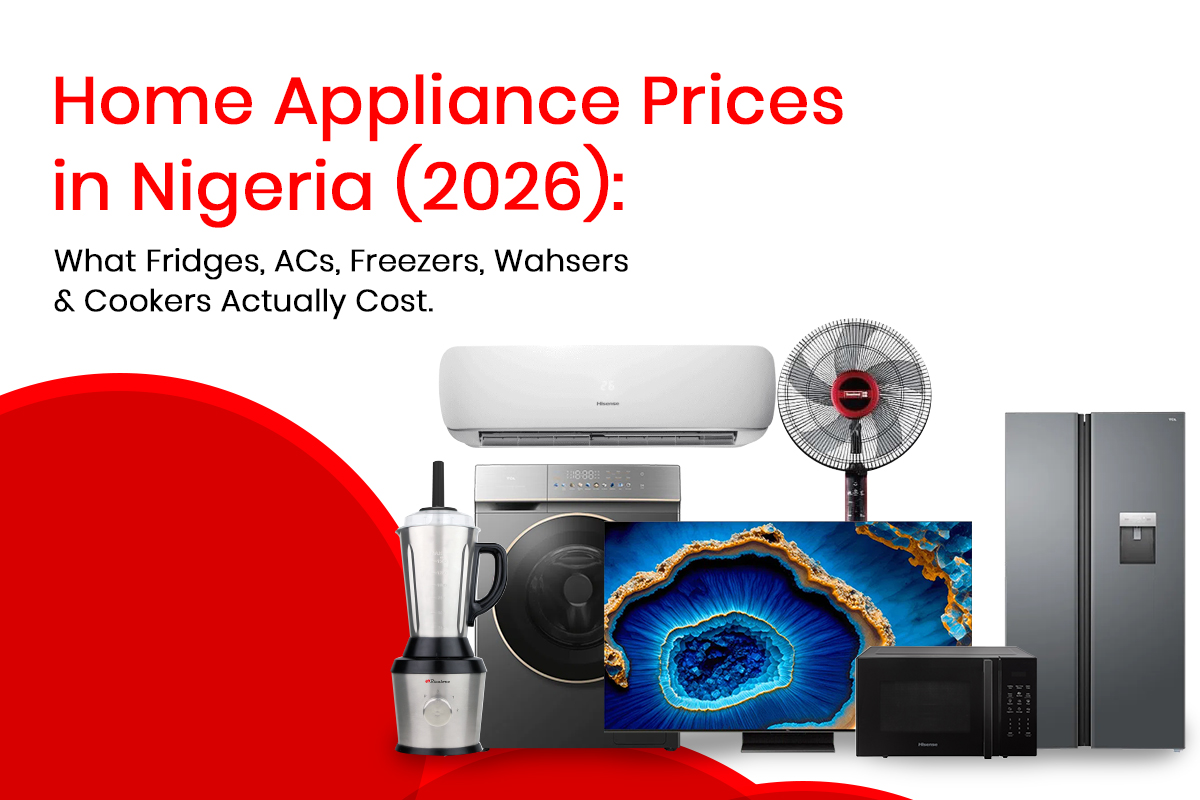
Home appliance prices in Nigeria in 2026 range from about ₦75,000 for a 20L microwave to over ₦700,000 for a large double-door refrigerator. As a guide: a 121L single-door fridge costs around ₦254,100, a 100L chest freezer around ₦321,300, a 6kg twin-tub washing machine around ₦276,600, a 1HP split AC around ₦375,400–₦400,300, and a 4-burner standing gas cooker around ₦194,800. Exchange rates and seasonal demand drive most price movement.
Prices verified from slot.ng, August 2026.
Why Home Appliance Prices in Nigeria Move the Way They Do
Appliance pricing in Nigeria behaves differently from most consumer categories, and understanding why saves buyers real money.
Almost everything is import-linked. Whether a unit is fully imported or locally assembled from imported components, the cost base is denominated in foreign currency. When the Naira moves against the dollar, appliance prices follow; usually within weeks, and usually upward faster than they come back down. A price quoted in January may not hold in April.
Demand is strongly seasonal. Air conditioner and fan prices firm up sharply during the hot, dry stretch from roughly February through April, when demand spikes nationwide. Freezers and refrigerators see their own surge ahead of the December festive period, when households stock up and small food businesses expand capacity. Buying counter-seasonally, an AC in the rainy season, a freezer in the middle of the year is one of the few reliable ways to pay less for the same unit.
Grid instability shapes what's worth buying. Nigeria's power supply realities mean appliances here face voltage fluctuations and frequent outages that units in other markets never encounter. This is why inverter-compressor refrigerators, freezers and air conditioners have gained ground: they draw less power, run better on generator and solar-inverter setups, and tolerate the start-stop cycling that kills conventional compressors early. It's also why a stabiliser is not optional for large appliances in most Nigerian homes.
Warranty and authenticity are genuine risks, not marketing talk. Nigeria's appliance market contains a meaningful share of refurbished, ex-UK, and grey-market units sold as new. A refurbished compressor may run fine for six months and fail in the seventh, at which point a unit with no valid warranty and no traceable retailer becomes a total loss. Compressor and sealed-system repairs are among the most expensive in the appliance world often approaching a substantial fraction of the unit's replacement cost. This is the single strongest argument for buying from an authorized retailer with documented warranty coverage.
Stock availability is inconsistent. Specific capacities and model numbers move in and out of stock as shipments land. The 1.5HP inverter AC available this month may be replaced by a different SKU next month. Confirming live-stock before committing to a particular model prevents wasted trips and delayed installations.
Complete Guide to Home Appliance Prices in Nigeria by Category
Refrigerators
Refrigerator pricing tracks three things: total capacity in litres, whether the unit is single-door or double-door, and whether the compressor is conventional or inverter-driven.
Single-door models in the 90L–150L range serve small households, self-contained apartments, students, and offices. They're the entry point to the category. The Hisense 121L (model 121DR) sits in this bracket — enough capacity for a couple or small family's daily use without the footprint or power draw of a larger unit.
Double-door models from roughly 200L upward add a separate freezer compartment with its own door, which improves temperature stability and reduces frost transfer. The Hisense 225L (model 29DCA-RD) is a representative mid-tier double-door unit suited to a family of four to six.
What drives price up within the category: larger capacity, inverter compressors, frost-free operation, and water dispensers. Frost-free is worth understanding clearly — it eliminates manual defrosting but typically costs more and consumes slightly more energy than a direct-cool unit of equivalent size.
|
Model |
Type |
Capacity |
Price (₦) |
Availability |
|
Hisense 121DR Silver |
Single door |
121L |
254,100 |
In stock |
|
Hisense 29DCA-RD |
Double door |
225L |
Call to Confirm |
Confirm |
|
LG 312PFGB |
Double door |
330L |
705,200 |
On request |
Prices verified from slot.ng, August 2026, except where marked.
Chest Freezers
Chest freezers are the workhorse appliance of Nigerian households and small food businesses, and pricing scales fairly predictably with capacity.
Small (roughly 90L–110L): Suited to households with modest frozen-storage needs or as a supplementary unit. The Scanfrost SFL100 Eco and Hisense 95L (120SH) occupy this tier.
Medium (roughly 140L–160L): The most common household size, balancing capacity against floor space and running cost. The Scanfrost SFL150 Eco and Hisense 142L (180SH) sit here, alongside the Haier Thermocool HTF-219TS in the larger part of this band.
Large (roughly 200L–250L and above): Aimed at large families, caterers, frozen-food retailers, and anyone buying protein in bulk. The Scanfrost SFL250 Eco anchors this tier.
Inverter chest freezers, such as the Midea Inverter Chest Freezer, carry a price premium over conventional models but reduce electricity consumption meaningfully and run far more comfortably on generator or solar-inverter power. For households running off-grid a significant portion of the day, the higher purchase price often pays back through lower fuel and power costs.
|
Model |
Capacity |
Type |
Price (₦) |
Availability |
|
Scanfrost SFL100 Eco |
~100L |
Conventional |
321,300 |
In stock |
|
Hisense 120SH |
95L |
Conventional |
Call to Confirm |
Confirm |
|
Scanfrost SFL150 Eco |
~150L |
Conventional |
Call to Confirm |
Confirm |
|
Hisense 180SH Silver |
142L |
Conventional |
271,800 |
In stock |
|
Haier Thermocool HTF-219TS |
~219L |
Conventional |
Call to Confirm |
Confirm |
|
Hisense 320SH |
240L |
Conventional |
372,400 |
In stock |
|
Scanfrost SFL250 Eco |
~250L |
Conventional |
Call to Confirm |
Confirm |
|
Midea Inverter Chest Freezer |
Confirm |
Inverter |
Call to Confirm |
Confirm |
Prices verified from slot.ng, August 2026, except where marked.
Washing Machines
Browse washing machines at SLOT
Washing machine pricing is driven by load capacity in kilograms, and by whether the machine is semi-automatic (twin-tub, manual water filling and transfer) or fully automatic.
5kg machines like the Hisense WM-WSPA503 suit singles, couples, and small households washing a few loads weekly.
7.5kg machines such as the Hisense WM-753WSQB handle a family of four comfortably, including bedding and larger items.
11kg machines serve large households or anyone washing heavy items; duvets, curtains, work uniforms regularly.
The practical guidance: buy slightly above your current need rather than exactly at it. Overloading a machine is one of the fastest ways to wear out its motor and bearings, and undersized machines get overloaded constantly. Also account for water supply — fully automatic machines assume reliable pressurised water, which not every Nigerian home has.
|
Model |
Capacity |
Type |
Price (₦) |
Availability |
|
Hisense WM-WSPA503 |
5kg |
Top load |
Call to Confirm |
Confirm |
|
Scanfrost Twin Tub |
6kg |
Semi-automatic |
276,600 |
In stock |
|
Hisense WM-753WSQB |
7.5kg |
Top load |
Call to Confirm |
Confirm |
|
Hisense Front Loader |
Confirm |
Front load |
434,700 |
In stock |
|
Hisense 11kg |
11kg |
Top load |
Call to Confirm |
Confirm |
|
LG T1385NEHT2 |
13kg |
Top load |
513,600 |
On request |
Air Conditioners
Browse air conditioners at SLOT
AC pricing turns on three variables: horsepower rating, split versus standing configuration, and conventional versus inverter compressor.
Horsepower to room size is the sizing fundamental most buyers get wrong. As a working guide: 1HP suits a small bedroom, 1.5HP a standard bedroom or small sitting room, 2HP a larger living space, and 3HP a large open room or small commercial space. Undersizing means the unit runs continuously without ever reaching target temperature — which raises the electricity bill and shortens compressor life. Oversizing wastes money upfront and cools in short bursts that leave humidity behind.
Split ACs mount the compressor outside and the blower unit inside. They're quieter indoors and more efficient, but require professional installation and permanent wall mounting. The Hisense 1.5HP Inverter Split AC, Royal Split AC 1HP, Lontor 1HP Split AC, and Haier Thermocool 1HP (09TESN) cover the common residential range.
Standing (floor-mounted) ACs like the Hisense 2HP (Inverter) deliver higher output for larger spaces and need no wall mounting, but occupy floor area and cost more per unit of cooling.
Inverter versus conventional is the most consequential decision in this category for Nigerian buyers. Inverter ACs modulate compressor speed instead of cycling fully on and off, cutting electricity consumption significantly and placing far less strain on generators and inverter systems at startup. They cost more upfront. For anyone running AC for several hours daily, especially on generator power, the running-cost difference typically justifies the premium.
|
Model |
HP |
Type |
Configuration |
Price (₦) |
Availability |
|
Royal FE09RSA Basic (with kit) |
1HP |
Conventional |
Split |
375,400 |
In stock |
|
Haier Thermocool 09TESN Split Cool |
1HP |
Confirm |
Split |
400,300 |
On request |
|
Lontor Split AC |
1HP |
Conventional |
Split |
Call to Confirm |
Confirm |
|
Midea MSAF-12CRNI |
1.5HP |
Confirm |
Split |
Call to Confirm |
Confirm |
|
Hisense Inverter Split AC |
1.5HP |
Inverter |
Split |
Call to Confirm |
Confirm |
|
Hisense AF30FC |
3HP |
Confirm |
Standing |
Call to Confirm |
Confirm |
Gas Cookers
Gas cooker pricing follows size and configuration. The naming convention is straightforward once decoded: a Maxi 5050 indicates a roughly 50cm × 50cm footprint, typically a four-burner unit suited to compact kitchens. A Maxi 6060 indicates roughly 60cm × 60cm, generally accommodating more burners and a larger oven cavity.
What to check beyond size: burner material and construction quality, whether the oven is gas or electric (or both), the presence of auto-ignition, and critically flame failure safety devices that cut gas flow if a flame goes out. That last feature matters more in homes with children and is worth confirming rather than assuming.
|
Model |
Size |
Configuration |
Price (₦) |
Availability |
|
Maxi Standing 50/50 |
~50×50cm |
4 burner |
194,800 |
On request |
|
Maxi 6060 |
~60×60cm |
Confirm burners |
Call to Confirm |
Confirm |
|
Maxi Table Top MAXI-200 |
Table top |
2 burner |
27,200 |
On request |
Prices verified from slot.ng, August 2026, except where marked.
Microwaves
Microwave pricing is the most compressed of any category here, driven mainly by capacity and whether the unit offers solo, grill, or convection functionality.
20L models such as the LG MWO-2032 and Hisense 20MOMS10-H handle standard reheating and defrosting for most households. 23L models like the Samsung 23L offer additional interior room for larger plates and dishes.
Solo microwaves reheat and defrost only. Grill models add a heating element for browning. Convection models function as a compact oven as well, and sit at the top of the price range.
|
Model |
Capacity |
Type |
Price (₦) |
Availability |
|
Hisense 20MOWS10-H White |
20L |
Solo |
75,100 |
On request |
|
Hisense 20MOMS10-H |
20L |
Confirm |
91,500 |
In stock |
|
LG MWO 2032 Smart Inverter |
20L |
Inverter |
127,900 |
In stock |
|
Samsung 23L |
23L |
Confirm |
Call to Confirm |
Confirm |
Prices verified from slot.ng, August 2026, except where marked. Note: the catalogue lists the LG MWO 2032, not the MWO-2044 in the original brief confirm which model is current.
Key Features to Consider Before Buying
Performance
-
Correct capacity or HP rating for your actual space and household size the most common and most costly sizing error
-
Inverter versus conventional compressor, particularly for refrigerators, freezers and ACs
-
Energy efficiency rating, which compounds meaningfully over an appliance's lifespan
-
Cooling or heating recovery speed after door opening or power restoration
-
Noise output, which matters disproportionately for bedroom ACs and kitchen-adjacent freezers
Durability
-
Compressor quality and origin, the single most important longevity factor in any refrigeration appliance
-
Build materials, particularly interior lining, door seals, and shelf construction
-
Voltage tolerance range and built-in surge protection, given Nigerian grid conditions
-
Corrosion resistance on external condenser units for split ACs, especially in coastal and humid areas
-
Availability of spare parts locally, a brand with no local parts pipeline becomes disposable when something fails
Warranty
-
Manufacturer warranty duration, which typically differs between the compressor and the rest of the unit
-
Whether the warranty is registered to you at point of sale, not merely promised verbally
-
Whether the retailer can actually service the claim, or will redirect you to a third party
-
What voids coverage, improper installation, no stabiliser, and unauthorised repair attempts are common exclusions
-
Availability of extended warranty or service plans on higher-value units
Expert Buying Advice
What experts check first: Before anything else: the compressor. On refrigerators and freezers, it determines whether the appliance lasts three years or twelve. Confirm it's an inverter or a reputable conventional compressor, and confirm the warranty terms covering it specifically compressor warranties are frequently longer than the general unit warranty, and that distinction matters. Next, check the serial number and confirm the unit is new rather than refurbished. Then verify the retailer's after-sales service arrangement is real: ask who performs warranty repairs and where.
Common mistakes: Sizing by price rather than by need is the most expensive error in this category. An undersized AC or freezer costs more in electricity over two years than the money saved at purchase. Skipping a stabiliser on a large appliance is the second. Buying from an informal seller because the price is lower, and discovering the unit is refurbished with no recourse, is the third.
Hidden specs that matter: Voltage tolerance range determines whether an appliance survives Nigerian grid fluctuation, a unit rated for a narrow voltage band will fail here regardless of brand reputation. Refrigerant type matters for both efficiency and future servicing cost. For freezers, holding time (how long contents stay frozen during a power outage) is rarely advertised but hugely relevant in practice. For ACs, the installation quality pipe run length, vacuum procedure, gas charge affects performance and lifespan as much as the unit itself.
Longevity factors. Appliances in Nigeria fail earlier than their rated lifespan for predictable reasons: unstabilised power, poor installation, overloading, and deferred maintenance. A refrigerator with clean condenser coils and a working stabiliser routinely outlasts an identical unit without them by years. Air conditioners need filter cleaning at minimum every few months in dusty conditions, and a full service annually. None of this is expensive; all of it is commonly skipped.
Recommended Options at SLOT by Household Type
Small household or single occupant. A single-door refrigerator such as the Hisense 121DR (₦254,100), paired with a compact top-loader washing machine (from ₦155,200) and a 20L microwave like the Hisense 20MOMS10-H (₦91,500), covers daily needs without oversized power draw or footprint.
Family of four to six. A mid-capacity chest freezer such as the Hisense 142L 180SH (₦271,800) or Scanfrost SFL100 Eco (₦321,300), a 6kg Scanfrost twin-tub washer (₦276,600) or a Hisense front loader (₦434,700), and a Maxi 50/50 four-burner standing gas cooker (₦194,800) match typical family volume.
Large household or bulk-buying family. A 240L-class chest freezer such as the Hisense 320SH (₦372,400), a large-capacity washer like the LG T1385NEHT2 13kg (₦513,600), and a double-door refrigerator such as the LG 330L 312PFGB (₦705,200) handle higher throughput without constant overloading.
Off-grid, generator-dependent or solar-inverter homes. Prioritise inverter technology across the board — inverter compressors reduce startup surge and running load substantially, which translates directly into lower fuel consumption and less strain on inverter batteries. The LG MWO 2032 Smart Inverter microwave (₦127,900) is one example; confirm current inverter freezer and AC options with SLOT, as availability shifts.
Small food business or caterer. Large chest freezer capacity is the priority, ideally split across two units rather than one. Two medium freezers give redundancy, if one fails, stock isn't lost entirely.
Market Pricing Insight: How Nigerian Appliance Prices Behave
Several forces shape home appliance prices in Nigeria, and they operate on different timescales.
Exchange rate movement acts fastest and hits hardest. Because the cost base is foreign-currency denominated, Naira depreciation feeds into retail prices within weeks. Importantly, this adjustment is asymmetric, prices rise quickly when the Naira weakens, and recede slowly, if at all, when it strengthens.
Import duties, tariffs and port charges form a substantial component of landed cost, and policy changes in these areas move prices across entire categories simultaneously rather than brand by brand.
Seasonal demand creates predictable annual patterns. Cooling appliances firm up from February through April. Refrigeration and freezers climb ahead of December. Washing machines and cookers are comparatively stable year-round, making them less time-sensitive purchases.
Energy cost pressure has shifted demand structurally toward inverter and energy-efficient models. As electricity tariffs and fuel costs have risen, the total cost of ownership calculation has changed buyers increasingly weigh running costs against purchase price rather than optimising purchase price alone. This has pushed inverter models from the premium niche toward mainstream in ACs and refrigeration.
Local assembly moderates pricing for some brands. Manufacturers with Nigerian assembly operations avoid a portion of import duty on finished goods, which can translate into more stable pricing and better local parts availability.
"In stock" versus "on request" affects more than waiting time. A meaningful share of appliance listings in Nigeria are available on request rather than held in stock. Request items typically involve a lead time while the unit is sourced, and the quoted price is more exposed to exchange rate movement between order and delivery than an in-stock unit is. If you need an appliance immediately, a failed freezer with stock inside, for instance, filtering for in-stock items first is the practical move, even if a requested item looks better on paper.
Practical implication for buyers: the meaningful comparison is not the lowest price you can find, but the price at which you also get a valid warranty, verified authenticity, and functioning after-sales support. A unit priced below the market range usually differs from the market in some material way, refurbished status, grey-market import without local warranty, or an older model being cleared.
Pro Tips From SLOT Experts
-
Buy cooling appliances off-season. Purchase air conditioners during the rainy season and freezers mid-year rather than in December. The same unit costs less when demand is low.
-
Budget for the stabiliser at purchase, not later. For any refrigerator, freezer or AC, a stabiliser is part of the cost of ownership. Buying one after a voltage spike destroys the compressor is a false economy.
-
Confirm warranty registration in your name before you leave. A verbal warranty promise with no documentation is not a warranty.
-
Use professional installation for split ACs. Improper installation is a leading cause of early AC failure and frequently voids warranty coverage. The installation saving is never worth the risk.
-
Size up modestly on washing machines and freezers. Chronic overloading shortens lifespan more than the incremental cost of the next size up.
-
Ask about delivery and installation before ordering. Large appliances need scheduling, access measurement, and sometimes doorway clearance checks. Confirm this upfront.
-
Keep the receipt and serial number recorded separately. Warranty claims are far smoother with documentation, and a photographed receipt survives what a paper one in a kitchen drawer may not.
-
Ask about payment plans on higher-value units. Where available, spreading payment on a large purchase can allow you to buy the correctly-sized unit rather than compromising on capacity.
Common Mistakes Buyers Make
-
Sizing by budget instead of by need. An undersized AC or freezer runs continuously, costs more to operate, and fails earlier. The cheapest unit is frequently the most expensive over three years.
-
Buying refurbished units sold as new. Common in the informal market and difficult to detect visually. The failure typically arrives after the seller has become unreachable.
-
Running large appliances without a stabiliser. Voltage fluctuation destroys compressors, and this damage is routinely excluded from warranty coverage.
-
Ignoring energy efficiency. Purchase price is paid once; electricity cost is paid monthly for a decade. Efficiency differences compound substantially.
-
Skipping professional AC installation. Poor pipe runs, incorrect gas charge, and inadequate vacuuming cause performance loss and premature compressor failure.
-
Not verifying warranty terms before payment. Compressor and unit warranties often differ. Assuming they're the same leads to unpleasant surprises.
-
Neglecting routine maintenance. Dirty condenser coils and clogged AC filters cause the majority of avoidable failures and efficiency loss.
-
Buying from unverifiable sellers to save marginally. When something fails, the difference between an authorised retailer and an informal seller is the difference between a repair and a total loss.
Frequently Asked Questions About Home Appliance Prices in Nigeria
1. How much is a fridge in Nigeria in 2026?
Refrigerator prices depend on capacity and compressor type. A 121L single-door unit such as the Hisense 121DR costs around ₦254,100, while a large 330L double-door model like the LG 312PFGB reaches about ₦705,200. Confirm current pricing with an authorised retailer, as figures shift with exchange rates.
2. What is the price range for home appliances in Nigeria?
Based on current catalogue pricing: microwaves start around ₦75,100, table-top gas cookers from ₦27,200, standing gas cookers around ₦194,800, refrigerators from ₦254,100, chest freezers from ₦271,800, washing machines from ₦155,200, and split air conditioners from ₦375,400.
3. Which appliance brand lasts longest in Nigeria?
Longevity depends more on compressor quality, voltage protection and maintenance than on brand alone. Established brands with local service networks and parts availability including Hisense, Haier Thermocool, Scanfrost, Midea and LG are generally better supported for repair when issues arise.
4. Is it worth buying an inverter appliance in 2026?
For households running on generator or solar-inverter power, or using appliances for many hours daily, yes. Inverter models draw less power and place less strain on power systems, and the running-cost saving typically offsets the higher purchase price over time.
5. What size air conditioner do I need for my room?
As a general guide: 1HP for a small bedroom, 1.5HP for a standard bedroom or small sitting room, 2HP for a larger living space, and 3HP for a large open or commercial space. Undersizing raises electricity costs and shortens compressor life.
6. What should I avoid when buying appliances in Nigeria?
Avoid refurbished units sold as new, sellers who cannot provide warranty documentation, prices substantially below market range without explanation, and running large appliances without a stabiliser.
7. Where can I buy genuine home appliances in Nigeria?
Buy from authorised retailers such as SLOT Systems that provide verifiable warranty documentation, new sealed units, delivery and installation support, and accessible after-sales service.
8. Do appliance prices in Nigeria drop at any point in the year?
Cooling appliances tend to be cheaper outside the February–April hot season, and freezers outside the December festive period. Structural price declines are less common, since exchange-rate-driven increases rarely fully reverse.
9. What warranty comes with appliances bought from SLOT?
Appliances purchased through SLOT come with the manufacturer's official warranty. Duration varies by brand and category, and compressor coverage often differs from general unit coverage confirm specific terms at purchase.
Conclusion
Home appliance prices in Nigeria are shaped by forces most buyers never see, exchange rate movement, import duties, seasonal demand, and the widening gap between what an appliance costs to buy and what it costs to run. The buyers who do best are the ones who size correctly for their actual needs, weigh running cost alongside purchase price, protect their investment with proper power conditioning and installation, and buy where the warranty is real.
That last point carries more weight in this category than in almost any other. A compressor failure on an unwarranted refrigerator or freezer is not a minor inconvenience, it can approach the cost of replacement. Buying from an authorised retailer like SLOT Systems means a new unit, documented manufacturer warranty, professional delivery and installation, and after-sales support that remains reachable when you need it. Confirm current pricing and stock before ordering, since both move with the market.
Segun Olayemo