Best Power Banks in Nigeria (2026): Reliable Options for Blackouts
Segun Olayemo
15 October 2026 · 20 views
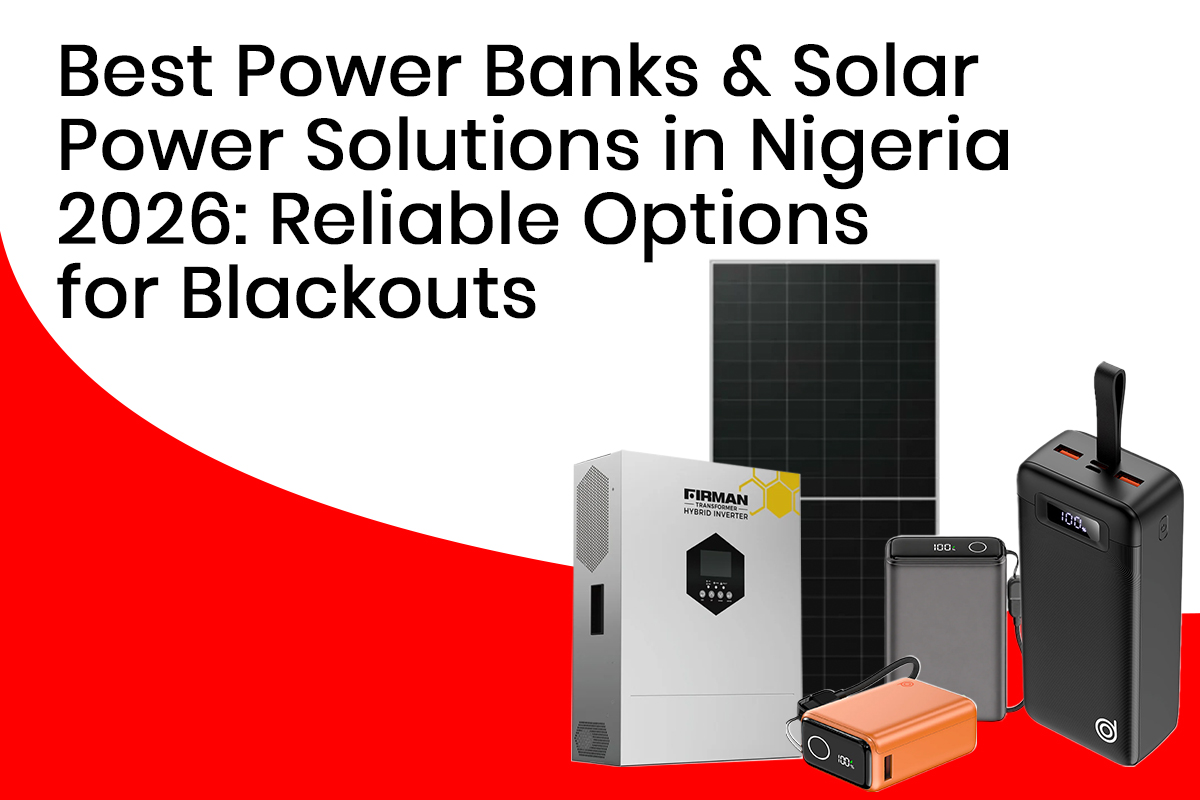
Choosing the best power banks in Nigeria means looking past the big number on the box. A power bank's mAh rating tells you less than most buyers think, and fake capacity claims are common. This guide explains what the specifications really mean, which capacity suits your day, which models charge laptops, and when a portable power station is the better choice for long outages.
The best power bank in Nigeria depends on use. A 10,000mAh bank with 22.5W fast charging suits daily phone top-ups. A 20,000mAh bank covers two to four phone charges. A 65W or higher USB-C PD bank can charge laptops. For long blackouts running fans, routers or TVs, a portable power station is better.
Why This Matters in Nigeria
Blackouts make a power bank essential, not optional. With unreliable grid supply, a charged phone can mean the difference between working, banking, calling for help, or being cut off. For many people, a power bank is the first piece of backup power they own.
Fake capacity is common. Power banks advertising 30,000mAh or more at very low prices are widely sold in open markets and online. Many contain far smaller cells, and some contain weights to make them feel substantial. You only discover the real capacity when the bank runs flat far sooner than expected.
Poor-quality power banks are a fire risk. Lithium batteries without proper protection circuits can overheat, swell or catch fire, especially in high temperatures. Genuine products from established brands include protection against overcharging, short circuits and overheating.
Recharge windows are short. When grid power returns for only a few hours, a power bank that recharges slowly may never fill completely. Input charging speed matters as much as output speed in Nigeria, and it is rarely discussed.
Prices move with the exchange rate. Power banks and power stations are imported, so prices change. Between 7 September and 13 October 2026, some portable power stations at SLOT rose by 6% to 15% while others stayed flat. Confirm prices close to purchase.
Warranty protects you from early failure. Batteries are the component most likely to fail. A documented warranty from an authorised retailer is the only practical recourse if a power bank stops holding charge.
Availability varies by model and capacity. Popular capacities and colours sell out. Confirm stock before travelling to a store.
What mAh Really Means (and Why You Get Less)
mAh (milliamp-hours) measures battery capacity. Power banks are rated at their internal cell voltage, usually 3.6V to 3.85V. When they charge your phone, they convert that to 5V or higher, and some energy is lost as heat in the process.
The result: a power bank typically delivers around 60% to 70% of its rated capacity to your device. This is normal for genuine power banks and is not a defect.
Watt-hours (Wh) are a more useful measure because they account for voltage. To convert:
Wh = mAh × 3.7 ÷ 1,000
So a 20,000mAh power bank holds about 74Wh.
How Many Charges Will You Get?
Based on a typical smartphone battery of around 4,500 to 5,000mAh and normal conversion losses:
|
Power bank capacity |
Approx. energy |
Estimated phone charges |
Laptop use |
Flight carry-on (IATA guidance) |
Best for |
|
10,000mAh |
~37Wh |
1.5 to 2 |
Rarely |
Allowed |
Daily carry, pocket or handbag |
|
20,000mAh |
~74Wh |
3 to 4 |
Partial charge (if PD 45W+) |
Allowed |
All-day use, short outages, travel |
|
30,000mAh |
~111Wh |
5 to 6 |
About 1 charge (if PD 65W+) |
Airline approval usually needed |
Multi-day outages, families |
|
50,000mAh |
~185Wh |
8 to 10 |
1 to 2 charges (if PD 65W+) |
Generally not permitted |
Home backup, extended blackouts |
Estimates vary by phone model, cable quality and temperature. IATA guidance: power banks under 100Wh are generally allowed in carry-on baggage; 100 to 160Wh usually need airline approval; above 160Wh are generally prohibited. Power banks are not allowed in checked baggage. Always confirm with your airline.
Fast Charging Explained: Watts, PD and PPS
Charging speed is measured in watts (W). Higher wattage means faster charging, as long as your phone supports it.
-
10W to 12W: standard charging. Slow for modern phones.
-
18W to 22.5W: fast charging for most smartphones. Enough for quick top-ups.
-
45W to 65W: fast enough for many laptops, tablets and phones with high-speed charging.
-
87W to 100W: suitable for larger laptops.
USB Power Delivery (USB-C PD) is the main fast-charging standard for iPhones, many Android phones and most USB-C laptops. If you use an iPhone 15 or later, or a USB-C laptop, choose a power bank with USB-C PD output.
PPS (Programmable Power Supply) is part of USB PD and is needed for Samsung's Super Fast Charging. Without PPS, a Samsung phone will charge, but more slowly.
Input speed matters too. Input speed is how fast the power bank itself recharges. A 20,000mAh bank with slow input can take most of a day to refill. In a home where grid power comes back for a few hours at a time, fast input charging means the bank is actually full when the next outage starts.
Power Banks for Laptops
Not every power bank can charge a laptop. You need three things:
-
USB-C PD output at a wattage close to your laptop's charger rating. Check the wattage printed on your laptop charger.
-
Enough capacity. Most laptop batteries hold 40Wh to 70Wh. A 20,000mAh bank (~74Wh) delivers roughly one partial to full charge after losses.
-
A suitable cable, rated for the wattage. A 60W or 100W USB-C cable is needed for higher-power charging.
A 65W power bank will charge most ultrabooks and many business laptops. Gaming and workstation laptops usually need more power than any power bank can supply.
Power Bank vs Portable Power Station
When outages last many hours, the choice moves from power banks to portable power stations.
|
Feature |
Power bank |
Portable power station |
|
Typical capacity |
10,000 to 50,000mAh (~37 to 185Wh) |
Several hundred Wh to several kWh |
|
Outputs |
USB-A, USB-C |
AC sockets, USB, sometimes DC car port |
|
Runs a fan, TV or router? |
Usually no (USB devices only) |
Yes, within its output rating |
|
Portability |
Pocket or bag |
Carry handle, some on wheels |
|
Solar charging |
Rarely practical |
Yes, with external panels |
|
Best for |
Phones, tablets, laptops |
Whole-room essentials during blackouts |
|
SLOT price range |
₦110,400 to ₦3,638,000 |
A note on built-in solar power banks: power banks with small solar panels on the case charge very slowly from sunlight, often taking days to fill. They are useful for emergency trickle charging but should not be relied on as a main charging method. For real solar charging, use a separate panel with a power station.
Key Features to Consider
Performance
-
Rated capacity in mAh, and Wh if listed
-
Output wattage per port and total combined output
-
USB-C PD support, plus PPS for Samsung phones
-
Input (recharge) wattage, which determines how fast the bank refills during short grid windows
-
Number and type of ports, and whether several devices can charge at once
-
Pass-through charging (charging the bank and your phone at the same time), useful when grid time is limited
Durability
-
Lithium-polymer cells, which are common in slim designs and generally stable
-
Protection circuits against overcharge, over-discharge, short circuit and overheating
-
Solid casing that resists drops and does not bulge
-
Weight consistent with capacity: a genuine 20,000mAh bank typically weighs around 350g to 450g. One that feels unusually light is a warning sign
-
Heat tolerance; avoid leaving any power bank in a parked car or direct sun
Warranty
-
Documented manufacturer warranty, with the duration stated
-
Proof of purchase from an authorised retailer
-
Serial number or batch code on the device
-
Clear claim process through the retailer or brand service centre
Expert Buying Advice
What experts check first. The output wattage and charging standard, matched to the devices being charged. A large power bank with slow output will still charge a modern phone slowly. Then the weight and build quality, which quickly expose fake capacity. Then the input speed, which matters more in Nigeria than almost anywhere else.
Common mistakes. Buying the highest mAh number available without checking output speed. Expecting a power bank to run a fan or router. Buying a 30,000mAh or 50,000mAh bank for air travel without checking airline rules. Using a cheap cable that limits fast charging.
Hidden specs that matter. Total combined output: a bank rated 65W may drop to much lower per-port speeds when several devices charge at once. Low-current mode for earbuds and smartwatches, which otherwise may not draw enough power to keep a bank switched on. Self-discharge rate, which determines how much charge a stored bank keeps. Cycle life, which determines how many full charges the battery can handle before capacity fades noticeably.
Longevity factors. Heat is the main cause of battery degradation. Keep power banks out of direct sun and hot cars. Avoid storing them completely empty for long periods; around half charge is best for storage. Use quality cables and chargers. Replace any power bank that swells, gets unusually hot, or smells unusual.
Recommended Options at SLOT
Compact daily carry (10,000mAh)
For a pocket or handbag, the SLOT 10000mAh PD 22.5W Power Bank, Sporty 10000mAh PD 22.5W Power Bank and Digifon Mini Vault X 10000mAh give one and a half to two phone charges with 22.5W fast charging. All three are suited to daily top-ups rather than long outages.
All-day and short outages (20,000mAh)
The most balanced capacity for most people. The Oraimo 20000mAh Power Bank, Infinix XP20, Tecno TBP-P204 and Digifon WX2 20000mAh each give three to four phone charges and stay within standard airline carry-on limits.
Laptops and fast charging (65W and above)
For USB-C laptops, choose higher output. The Digifon Mini Vault XE Pro 20000mAh 65W covers most ultrabooks. The Anker 20000mAh 87W Power Bank with built-in USB-C cable handles larger laptops and removes the need for a separate high-wattage cable.
Multi-day blackouts (30,000mAh to 50,000mAh)
For households sharing one bank, or outages lasting a day or more, the Infinix XP30 and Digifon WX3 30000mAh give five to six phone charges. The Sporty 50000mAh 65W Power Bank gives eight to ten phone charges and can charge a laptop, but at about 185Wh it is generally not permitted on flights. Treat it as a home backup.
Beyond USB: portable power stations
When you need to run a fan, router, TV or lights, a power station replaces the power bank:
|
Product |
Price (₦) |
Availability |
|
Itel AIE IESS-320T (Power Go) |
110,400 |
On request |
|
Eden 300W Portable Powerbank |
273,000 |
On request |
|
309,000 |
In stock |
|
|
310,000 |
In stock |
|
|
Hithium 1000W Power Station |
313,900 |
In stock |
|
425,500 |
In stock |
|
|
442,000 |
On request |
|
|
598,000 |
In stock |
|
|
941,000 |
In stock |
For solar recharging, panels at SLOT range from the Eden 50W Monocrystalline (₦46,000) to the 400W Foldable Solar Panel (₦482,000). See the full range in Power Solutions.
Power Bank Specification Summary
|
Model |
Capacity |
Output |
Best for |
Price (₦) |
|
SLOT 10000mAh PD |
10,000mAh |
22.5W PD |
Daily carry |
₦14,000 |
|
Sporty 10000mAh PD |
10,000mAh |
22.5W PD |
Daily carry |
₦15,600 |
|
Digifon Mini Vault X |
10,000mAh |
22.5W |
Daily carry |
₦39,100 |
|
Oraimo 20000mAh |
20,000mAh |
- |
All-day use |
₦19,900 |
|
Infinix XP20 |
20,000mAh |
- |
All-day use |
₦12,400 |
|
Tecno TBP-P204 |
20,000mAh |
- |
All-day use |
[₦15,500 |
|
Digifon WX2 |
20,000mAh |
22.5W |
All-day use |
₦42,000 |
|
Digifon Mini Vault XE Pro |
20,000mAh |
65W |
Laptops |
₦68,700 |
|
Anker 87W (built-in USB-C) |
20,000mAh |
87W |
Laptops |
₦69,500 |
|
Infinix XP30 |
30,000mAh |
- |
Multi-day outages |
₦25,400 |
|
Digifon WX3 |
30,000mAh |
- |
Multi-day outages |
₦48,000 |
|
Sporty 50000mAh |
50,000mAh |
65W |
Home backup, laptops |
₦58,100 |
Market Pricing Insight
Counterfeits set a false price floor. Very cheap "high-capacity" power banks make genuine products look expensive. The fair comparison is genuine against genuine. A fake bank that delivers a fraction of its claimed capacity costs more per real charge, and it may be unsafe.
Price per watt-hour is the honest comparison. Divide the price by the Wh capacity to compare banks of different sizes. Larger banks usually cost less per Wh, but only if the capacity is genuine.
Fast charging adds cost. Higher-output banks (65W and above) cost more because they need better circuitry and cells that can deliver high current safely. For phone-only use, 22.5W is usually enough. Pay for 65W or more only if you charge a laptop.
Power stations reprice faster than power banks. Between 7 September and 13 October 2026, the EcoFlow River 2 rose from ₦268,500 to ₦309,000 (about 15%) and the River 2 Pro from ₦529,000 to ₦598,000 (about 13%), while other power stations held steady. Higher-value imported battery products are more exposed to exchange rate and supply changes.
Local brands compete on value. Oraimo, Infinix, Tecno, Digifon and Sporty compete directly in the 10,000 to 30,000mAh range, which keeps prices competitive. International brands such as Anker tend to cost more and lead on high-output laptop charging.
Pro Tips From SLOT Experts
-
Match output to your device. An iPhone or recent Android needs USB-C PD for fast charging. A Samsung phone needs PPS for its fastest speeds.
-
Check the weight. A genuine 20,000mAh power bank feels substantial. A very light one is a red flag.
-
Prioritise fast input if outages are frequent. It lets the bank refill during short grid windows.
-
Use a quality cable. A cheap cable can cut charging speed in half.
-
Charge the bank whenever power is available, even partially. Lithium batteries do not need to be fully drained first.
-
Store at about half charge if you won't use the bank for weeks.
-
Keep it out of the car. Heat shortens battery life and increases risk.
-
Check airline rules before flying with anything above 20,000mAh.
-
Use pass-through charging when grid power returns, so the phone and power bank both charge from one socket.
-
Move to a power station if you need to run anything other than USB devices.
Want to compare in person? Find a SLOT store near you to see and handle power banks before buying. For larger purchases, spread payment options are available. Answers to common questions about orders and warranty are on the SLOT FAQ page.
Common Mistakes Buyers Make
-
Believing the mAh number equals usable charge. Expect about 60% to 70% after conversion.
-
Buying fake high-capacity banks. Unrealistically cheap 30,000mAh+ banks often hold far less.
-
Ignoring output speed. A large slow bank charges modern phones slowly.
-
Ignoring input speed. A big bank that recharges slowly may never fill during short power windows.
-
Expecting a power bank to run a fan, TV or router. Most need AC power or special cables. A power station is the right tool.
-
Flying with a 50,000mAh bank. At about 185Wh it is generally not permitted.
-
Leaving power banks in hot cars. Heat damages batteries and can be dangerous.
-
Keeping a swollen power bank. Swelling means the battery is failing. Stop using it.
Frequently Asked Questions
What is the best power bank in Nigeria? It depends on use. For daily phone top-ups, a 10,000mAh bank with 22.5W fast charging is enough. For full-day use and short outages, 20,000mAh is the best balance. For laptops, choose 65W or higher USB-C PD, such as the Digifon Mini Vault XE Pro or Anker 87W.
How many times can a 20,000mAh power bank charge a phone? About three to four times for a typical smartphone with a 4,500 to 5,000mAh battery. Power banks deliver around 60% to 70% of their rated capacity because of voltage conversion losses.
Is a 50,000mAh power bank worth it? For home backup during long outages, yes. It gives eight to ten phone charges and, with 65W output, can charge a laptop. It is heavy, slow to recharge without fast input, and at about 185Wh is generally not allowed on flights.
Can a power bank charge a laptop? Yes, if it has USB-C Power Delivery output at a wattage close to the laptop's charger. A 65W power bank charges most ultrabooks. Larger laptops may need 87W to 100W.
Can I take a power bank on a plane in Nigeria? Power banks under 100Wh (about 27,000mAh) are generally allowed in carry-on baggage. Those between 100Wh and 160Wh usually need airline approval. Above 160Wh is generally prohibited. Power banks are not allowed in checked luggage. Check with your airline before flying.
How do I know if a power bank is genuine? Buy from an authorised retailer, check that the weight matches the capacity, look for a serial number and clear specifications, and be wary of prices far below the brand's normal retail price.
Power bank or portable power station: which is better for blackouts? A power bank charges phones, tablets and laptops. A portable power station has AC sockets and can run fans, routers, TVs and lights. For short outages and personal devices, choose a power bank. For long outages and household essentials, choose a power station.
Where can I buy genuine power banks in Nigeria? From authorised retailers such as SLOT Systems, online at slot.ng or in-store, with manufacturer warranty and after-sales support.
Segun Olayemo